Kaplan Turbine

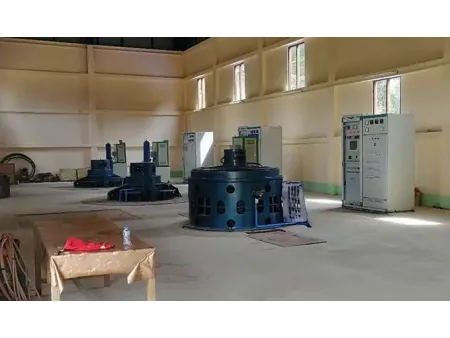
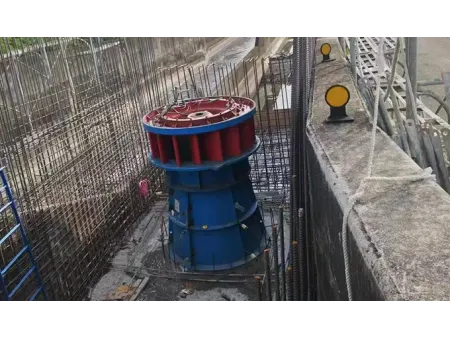

- Water head: 3-30m
- Power output: 50kW to 30MW
- Flow rate: 1-50m³/s
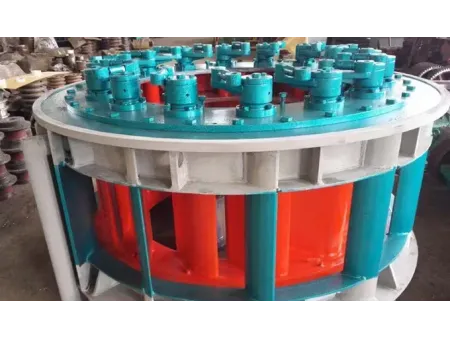
Kaplan turbines are reaction turbines in which water flows axially into the runner and exits along the blades in the same axial direction, converting hydraulic energy into mechanical energy. The runner consists of the runner body, blades, and draft tube cone. Compared to mixed-flow turbines, Kaplan turbines have fewer blades, and the blade axis is perpendicular to the turbine shaft.
Kaplan turbines are well suited for hydropower plants with low to medium head, typically ranging from 3m to 80m, and high flow rates. Under the same head conditions, Kaplan turbines have higher specific speeds compared to mixed-flow turbines.
Based on the blade mechanism, Kaplan turbines are classified into:
- Adjustable-blade turbines
- Fixed-blade turbines
- Bottom ring
- Draft tube
- Main Shaft
- Guide bearing
What is a Kaplan turbine?
A Kaplan turbine is a propeller-type axial-flow turbine with adjustable blades, specifically designed for low-head, high-flow applications.
What are the main components of a Kaplan turbine?
A Kaplan turbine consists of:
- Scroll casing, which directs water into the turbine while maintaining pressure
- Guide vane mechanism controlling the flow rate and water direction
- Draft tube, which converts kinetic energy into pressure energy
- Runner blades, which convert the water flow into rotational mechanical energy.
How does a Kaplan turbine work?
Water enters the scroll casing where pressure is maintained. It then passes through the guide vanes, which regulate flow and reduce turbulence. Next, the water reaches the runner blades, which adjust their pitch to optimize turbine performance. Finally, the water exits through the draft tube, where kinetic energy is converted into pressure energy. The rotation of the runner generates mechanical energy that can be converted to electricity.
What are the typical applications of Kaplan turbines?
Kaplan turbines are suitable for low-head, high-flow applications. They are usually applied in:
- Power generation
- Small-scale hydropower stations.
Large axial-flow turbines are specifically designed to achieve optimal performance at particular sites, offering long-term operational efficiency.
Why is the Kaplan turbine suitable for low head applications?
Their adjustable blades combined with an axial-flow design make them an ideal choice for environments characterized by low water levels but high flow rates, ensuring optimal performance in such settings.
What services do you provide for customers purchasing Kaplan turbines?
When you purchase turbines from our company, we provide a complete set of installation drawings. If required, we also assist and guide you through the installation process.