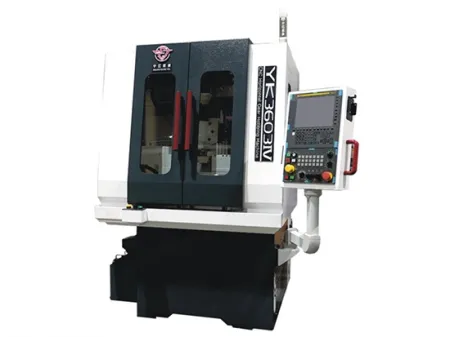
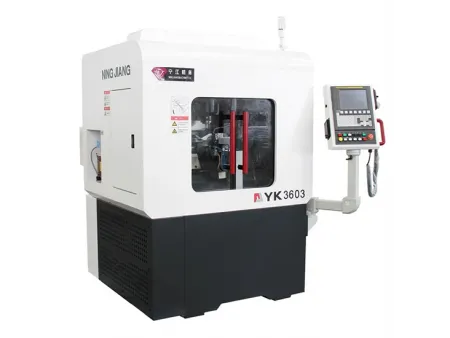
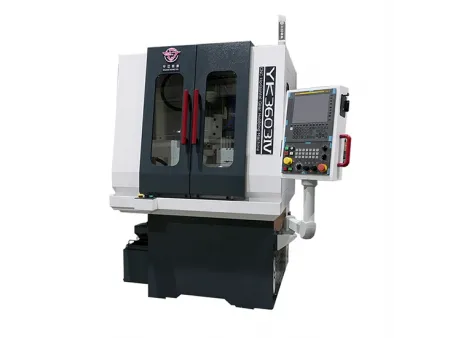
CNC Horizontal Gear Hobbing Machine


Request a Quote
3603 Series
Gear hobbing machine for the production of spur gears, helical gears, spindles, worms, chain sprockets and timing-belt gears up to Ø30mm
CNC horizontal gear hobbing machines in this size range are designed for workpieces up to Ø30 mm. They can machine a variety of small components used in precision devices, including spur gears, helical gears, worm gears, sprockets, timing-belt pulleys and splined parts. These gear cutting machines maintain steady mass-production accuracy at GB7, with fine cutting reaching GB6, making them suitable for efficient machining of small and micro-module gears in instrument and measurement applications.
Robot gear
Timing belt pulley
Pencil sharpener gear
Miniature reducer gears for smart furniture
Spur gears
Helical gears
Worm wheels
Small-module gears
Technical Specifications
| Model | | | |
| Number of controlled axes (pcs) | 8 | 5 | |
| Max. working diameter (mm) | ∅30 | ||
| Max.working module (mm) | 0.5 (optional: 0.8 for copper/aluminum easy-cut materials) | ||
| X-axis travel (mm) | 75 | 40 | |
| Y-axis travel (mm) | 90 | 90 | |
| Z-axis travel (mm) | 75 | 75 | |
| Z1-axis travel (mm) | 75 (servo) | 30 (pneumatic) | |
| Tooth range (teeth) | 3–999 | ||
| Hob head swing angel (°) | ±30 | ||
| Max. hob size (D x L) (mm) | ∅25×30 | ||
| Hob mandrel diameter (mm) | ∅3.5, ∅4.5, ∅5, ∅6, ∅8, ∅10 (available in long and short types) | ||
| X/Z-axis rapid speed (m/min) | 6 | ||
| Total power (kVA) | 6 | 5 | |
| Air supply | Air pressure (MPa) | 0.5–0.7 | |
| Air flow rate (L/min) | 200 | ||
| Machine dimensions (L×W×H) (mm) | 1795×1300×1899 (including operator panel space) | ||
| Machine weight (t) | 1.5 | 1 | |
Standard Components
FANUC 0i-MF Plus CNC System
Bearings
Ball Screw
Optional Configurations
Automated loading and unloading units can be added to handle shaft-type and disk-type gears, allowing continuous machining without manual intervention.
A secondary-tool station can be configured to perform post-cutting operations, such as deburring or light finishing, after the gear teeth are formed.
An optional deburring unit can remove burrs from the workpiece end face directly within the machining process.