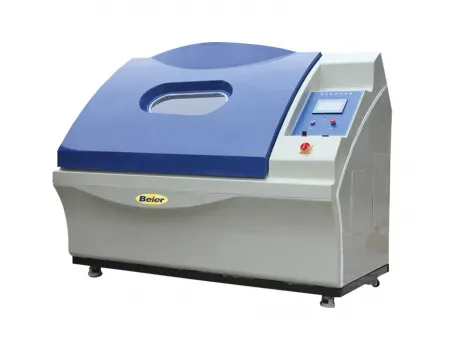
Salt Spray Test Chamber
Request a Quote
Environmental test chamber used for testing the corrosion resistance of products
Specifications
| Temperature Range | RT 5℃~55℃ |
| Saturated Air Barrel Temperature | RT 10℃~70℃ |
| Temperature Range | 30-98%RH |
| Spray Deposition | 1-2mL/80cm²·h |
| Temperature Deviation | ±2℃ |
| Humidity Deviation | 2%, -3% R.H |
| Temperature Fluctuation | ±0.5℃ |
| Spray Type | Continuous / Periodic (optional) |
What factors influence salt spray testing?
What factors influence salt spray testing?
Key influencing factors include test temperature and humidity, solution concentration, sample placement angle, pH value, salt spray fallout rate, and spraying method.
What is the difference between a composite salt spray corrosion test chamber and a traditional salt spray test chamber?
What is the difference between a composite salt spray corrosion test chamber and a traditional salt spray test chamber?
- Traditional Salt Spray Test Chamber: Primarily simulates a singular salt spray environment. Due to the limited environmental simulation, test results may not fully reflect a material's corrosion behavior in complex real-world conditions. It is suitable for testing materials and products with relatively straightforward requirements for a salt spray environment, such as assessing the corrosion resistance of ordinary metal products. These tests typically comply with standards like ASTM B117, ISO 9227, and others.
- Composite Salt Spray Corrosion Test Chamber: In addition to salt spray functionality, these chambers integrate multiple environmental simulation capabilities such as humid heat cycling, drying, and condensation. They can achieve alternating cycles of environmental conditions including salt spray, high temperature, low temperature, high humidity, and drying. This makes them suitable for simulating more complex working conditions, such as corrosion resistance and reliability testing for automotive components, aerospace materials, and electronic components under various environmental factors. These chambers are equipped with data monitoring and recording systems, allowing for real-time tracking of various parameters during the test, which facilitates analysis and traceability. They adhere to more complex cyclic corrosion standards like GMW 14872, SAE J2334, among others.
What are the roles of salt spray test chambers?
What are the roles of salt spray test chambers?
A salt spray test chamber is used to test the corrosion resistance of surface treatments such as painting, coating, and electroplating when exposed to a salt spray environment. The basic salt spray test chamber conforms to international test methods, including ASTM, ISO, and IEC standards.
What industries can use a corrosion testing chamber?
What industries can use a corrosion testing chamber?
Salt spray test chambers are suitable for industries like automotive, aerospace, coatings, and metals. They help in developing corrosion-resistant materials, which are crucial for product reliability and longevity.
Leave Message
Manufacturer Advertising
Similar Manufacturies and Parts