Ribbon Mixer / Ribbon Blender

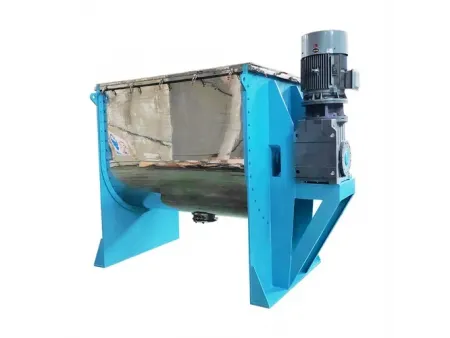
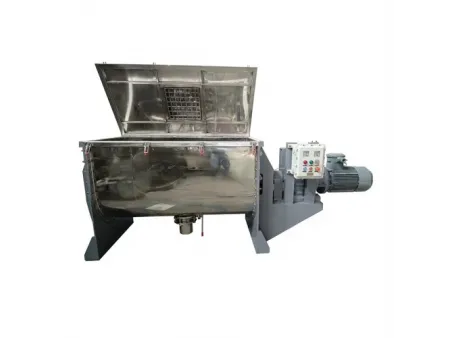
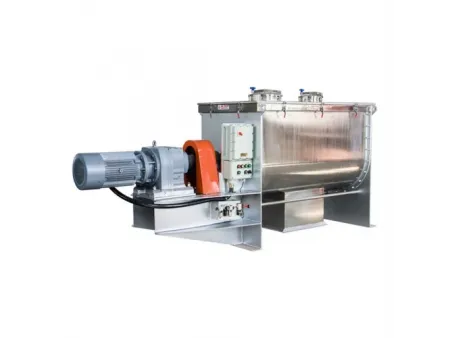

- Video
Ribbon mixers, also known as ribbon blenders, are used for mixing powders, granules, pastes, and liquid-powder materials in a horizontal mixing chamber. The main mixing part is a ribbon agitator with inner and outer helical blades arranged around the central shaft. As the shaft rotates, the outer ribbon moves material in one direction while the inner ribbon moves it in the opposite direction, creating axial and radial movement through the batch. This continuous movement helps different ingredients spread more evenly, supports gentle kneading for semi-wet or paste-like materials, and improves overall mixing consistency without using overly aggressive shear.
| Model | PRM | ||||||||||
| Nominal Volume (m³) | 0.5 | 1 | 2 | 3 | 4 | 5 | 6 | 8 | 10 | 12 | 15 |
| Working Capacity (%) | 0.4-0.6% | ||||||||||
| Motor Power (kW) | 5.5 | 11 | 15 | 18.5 | 22 | 30 | 37 | 45 | 55 | 55 | 75 |
| Rotation Speed (rpm) | 66 | 41 | 41 | 33 | 33 | 26 | 26 | 26 | 20 | 20 | 17 |
| Dimensions (L × W × H) (mm) | 1672 | 1970 | 2480 | 2880 | 3026 | 3518 | 3905 | 4398 | 4500 | 4486 | 5363 |
| 1142 | 1437 | 1561 | 1895 | 1947 | 1945 | 1683 | 1960 | 2070 | 2250 | 2250 | |
| 1300 | 1500 | 1830 | 2083 | 2235 | 2233 | 2286 | 3150 | 2667 | 2737 | 3070 | |
| Weight (kg) | 955 | 1400 | 2500 | 3300 | 3600 | 4620 | 5300 | 6800 | 8902 | 9520 | 9950 |
- Spiral Ribbon Mixing Blade
- Powder Feeding Inlet
- Explosion-Proof Operation Panel
- Siemens/ABB Motor and Inverter
Ribbon mixers are suitable for uniform blending of powders, granules, pastes, and liquid-powder materials with moderate shear, including food ingredients, pharmaceutical powders, chemical materials, battery materials, adhesives, and other dry or semi-wet formulations.
- Paints and Coatings
- Inks
- Leather Coatings
- Plastic Powder
- Viscous Materials
- Clay
- Chemicals
- New Materials
- The spiral ribbon blade pushes, folds, and turns thick materials through the mixing chamber, so high-viscosity pastes and semi-wet formulations can keep moving even when their natural flow is poor.
- As the ribbon blade moves the batch in different directions, powder and liquid stay in closer contact through the mixing chamber. Dry powder pockets are gradually reduced, wetting becomes more complete, and soft agglomerates break down more easily during the process.
- Low-speed, high-torque operation gives the ribbon mixer steady force for dense materials, with less vibration, lower noise, and reduced mechanical stress on the drive system and mixing structure.
- The ribbon mixer has a simple, sturdy internal structure that leaves enough room for the material to move through the chamber while keeping the ribbon blade close to the tank wall. More material stays in the active mixing area, so the batch can be mixed efficiently without requiring a larger footprint.
- Continuous ribbon rotation moves the mixed material toward the bottom discharge outlet, so unloading is more complete and less residue remains inside the chamber. Lower residue also reduces material waste and helps limit cross-contamination between batches.
Good Self-Cleaning and Reduced Material Buildup
The close gap between the ribbon blade and the inner tank wall keeps sticky materials moving during mixing and reduces buildup on the vessel surface. Less material remains on the wall during operation, which helps prevent crust formation, supports more consistent mixing, and reduces residue between batches.