Triple Shaft Mixer


- Video
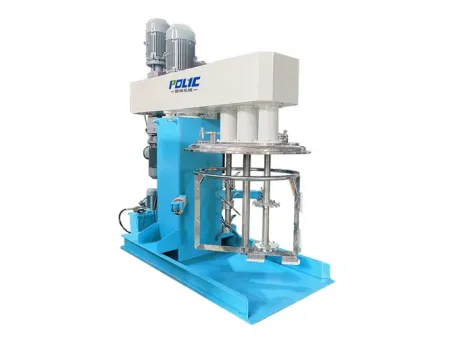
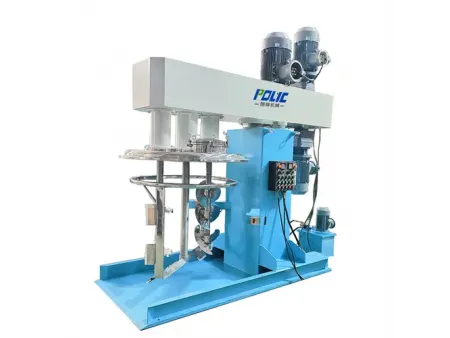
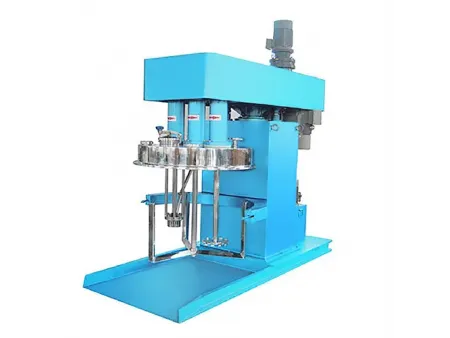
Triple shaft mixers are suitable for high-viscosity materials and mixing processes that need more than simple agitation. A floor-standing structure supports three independently driven shafts, usually combining high-speed dispersing shafts with low-speed scraping or mixing shafts. The high-speed shafts handle dispersion and particle deagglomeration, while the low-speed scraping shafts keep the batch circulating and move material away from the tank wall to reduce buildup. In the same tank, the mixer can disperse the material, keep the full batch moving, improve heat transfer through the vessel wall, and scrape material from the sides, which is useful for large-scale production that needs a uniform and stable final mixture.
| Model | Tank Capacity | Stirring Motor Power | Stirring Speed | Dispersing Motor Power | Dispersing Speed |
| L | kW | rpm | kW | rpm | |
| 600 | 15 | 0-40 | 22x2 | 0-1450 | |
| 1500 | 22 | 0-40 | 30x2 | 0-1000 | |
| 3000 | 30 | 0-40 | 37x3 | 0-1000 | |
| 5000 | 45 | 0-40 | 55x2 | 0-1000 |
- Customized Multi-Function Blades
- Explosion-Proof Control Panel
- Siemens/ABB Motor
- Siemens/ABB Inverter with Schneider Components
Widely used for wet mixing and dispersion of high-viscosity liquids, powder-liquid formulations, slurries, and pastes, especially materials that require strong dispersion, wall scraping, bulk circulation, and stable batch uniformity.
- Paints and Coatings
- Inks
- Leather Coatings
- Adhesives
- Viscous Materials
- Cosmetics
- Chemicals
- Glue
- The three shafts can complete different mixing tasks in the same tank, with the high-speed shaft dispersing the material, the medium-speed shaft helping create a more uniform mixture, and the low-speed shaft scraping the tank wall so thick material keeps moving instead of staying in one area.
- Viscous and paste-like materials can be processed efficiently because the three shafts disperse the material, keep the full batch circulating, and scrape product from the tank wall, which helps thick formulations move through the vessel more effectively than with a single mixing shaft.
- The scraping shaft keeps material from adhering on the tank wall and moves it across the heated or cooled surface, so heat transfers more evenly during production and the batch temperature is easier to control when shear creates extra heat.
- Strong shear and material circulation help powders enter the liquid phase more quickly, reducing powder agglomerates and improving powder wetting during mixing.
- Mechanical seals and explosion-proof configurations can be added when the mixer is used with solvents, flammable materials, or processes that require higher safety protection.
- PLC control allows process parameters to be set, recorded, and reused, making it easier to repeat established mixing conditions for future batches.
Technical Drawings
We can prepare technical drawings based on the required equipment configuration and project needs, with initial drawings available within 3 days. After order confirmation, we can also provide detailed assembly and disassembly diagrams, factory layout drawings, production line flowcharts, and other supporting documents for the corresponding equipment when needed.
Dispersing Disc Design
The wear-resistant stainless steel dispersing discs can be made with serrated edges to create the shear needed for dispersion. The disc structure can be chosen according to the shaft power, material viscosity, and process target, making replacement and cleaning easier during production.
Customized Vacuum, Heating, and Cooling Systems
Vacuum, heating, and cooling systems can be customized when the process requires deaeration, temperature control, or better protection for sensitive materials. For products with higher hygiene, corrosion-resistance, or cleanliness requirements, material contact parts can also be made from food-grade SS316L stainless steel.
Customized Shaft Functions