Grid Coupling


Request a Quote
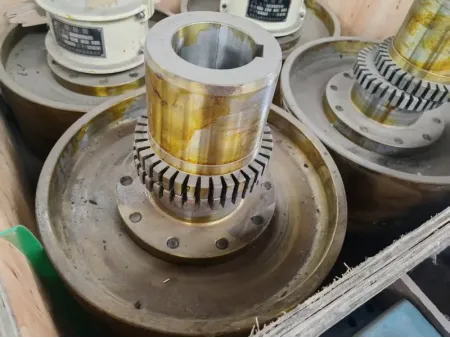
Grid couplings are built for heavy-duty drive systems operating under high torque, frequent impact, and demanding site conditions. They are commonly used in crushers, conveyors, and other equipment where stable power transmission and shock absorption are essential.
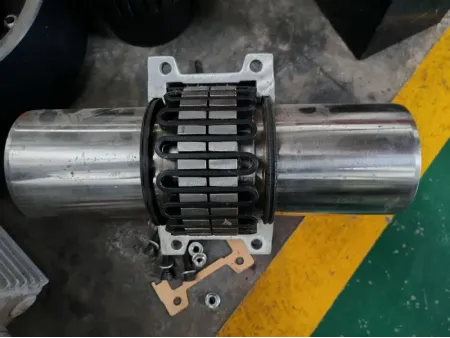
The coupling uses high-strength alloy steel hubs and a metallic grid spring to transmit torque efficiently while absorbing vibration and compensating for shaft misalignment. Its structure is suitable for frequent starts and stops, reversing operation, high-temperature environments, and oil-contaminated working conditions.
Working Principle
- The driving hub transmits torque to the grid spring through the gear grooves.
- The grid spring then drives the driven hub to rotate.
- Through elastic deformation of the grid spring, the coupling achieves torque transmission, misalignment compensation, and vibration damping.
Basic Data
- Torque Transmission
- Nominal torque range: 26–270000 N·m. Short-time overload capacity can reach 2–3 times the rated torque.
- Misalignment Compensation
- The grid coupling offers higher compensation capacity than jaw couplings.
- Radial compensation: 0.5–3 mm
- Angular compensation: 1°15′
- Axial compensation: 4–20 mm
- Vibration Damping & Cushioning:The metallic grid spring absorbs vibration, with a damping rate of approximately 36%, helping reduce resonance and making the coupling suitable for impact-load applications.
Specifications
| Parameter | Grid Coupling (JS) |
| Flexible Component | Metallic serpentine spring (steel) |
| Torque Capacity | Large (26–270000 N·m) |
| Compensation Capability | High |
| Vibration Damping Effect | Excellent (metal vibration absorption provides anti-resonance) |
| Operating Temperature | -40℃~ 150℃ |
| Maintenance Requirement | Requires lubrication and periodic maintenance |