Bronze Nuts


-
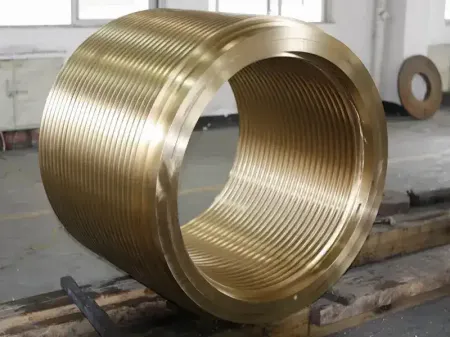
Maximum Outer Diameter up to 4000 mm
-
Maximum Weight of a Single Piece 5 tons
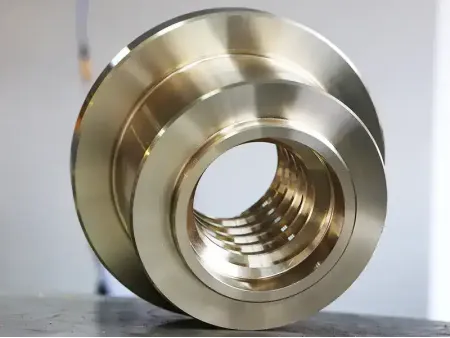
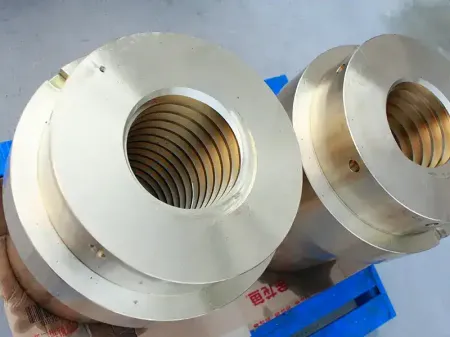
Bronze nuts are internally threaded components with either smooth or textured outer surfaces, depending on their application. They are available in several shapes and types, including hexagonal, square, knurled, wing, self-locking, and pressure nuts. The hexagonal type is the most common and can also include variations with retainers, rounded corners, or modified threads. Bronze nuts are also used in motion systems, such as jackscrews, where the screw rotates and the nut moves to lift or lower a load.
A range of copper alloys is available for bronze nuts; each selected according to the mechanical requirements and operating conditions of the equipment. Commonly used bronze alloys include C95800, C86300, and C95400.
| Material No. | | | |
| Category | Aluminum Bronze | Manganese Bronze | Aluminum Bronze |
| Core Properties | • High strength and hardness (tensile strength 800–950 MPa, HB 220–280) • Excellent resistance to wear, impact, and high temperatures • Stable performance under pressure and vibration | • Outstanding toughness and fatigue resistance • Performs well under impact and vibration loads • Reliable mechanical stability in demanding applications | • Low friction coefficient and excellent anti-seizing properties • Strong corrosion resistance, superior to standard tin bronze • High dimensional stability under heavy loads |
| Typical Applications | Suitable for gears, bearing plates, marine propellers, high-pressure valve cores, and petrochemical pipe fittings | Used for couplings, automotive shock-absorbing parts, machinery shafts, and bridge expansion joints | Ideal for large bearing sleeves, machine tool spindles, and hydraulic pump columns |
Bronze nuts are used in a wide range of industrial fields that require high load capacity and precise motion. Some typical applications include:
- Forging and lamination systems, such as presses and forging shafts.
- Rubber machinery, including vulcanizing and friction presses.
- Steel rolling mills and other heavy-duty drive systems.
- Mechanical jacks and leveling bases used for lifting and alignment.
Many of these applications use press nuts, cylinder adjustment nuts, forging shaft guide nuts, or thread adjustment nuts for vulcanizing machines.
For demanding conditions, aluminum bronze is the preferred material. Containing up to 11.5% aluminum with small additions of iron, nickel, and manganese, it offers excellent strength, wear resistance, and corrosion protection, even in air, freshwater, or seawater environments.