Hydroformed Subframe Components
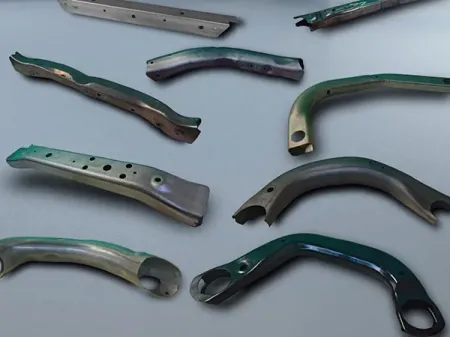
Hydroformed tubular components for automotive subframes and chassis systems
These hydroformed tubes are an important part of the vehicle chassis. By shaping the tubes with internal hydraulic pressure, the structure becomes lighter but still strong enough to handle the loads a car chassis needs to carry.
- Tube diameter Ø45–Ø160 mm
- Length up to 2400 mm
- Wall thickness 1.8–7.5 mm
- Integrated one-piece structure: Subframe hydroformed tubes are typically formed as a single structure combining the left and right longitudinal members with the rear cross member. In some designs, the front cross member and body mounting brackets are welded in to complete the frame. Fewer individual components and weld joints improve overall structural integrity and reliability.
- Optimized tube parameters: Tube diameter and wall thickness are adjusted according to the loads the part needs to carry. With variable cross-section hydroforming, the tube can be reinforced only where extra strength is needed, while the rest stays lighter. This helps keep the right balance between strength and stiffness during vehicle use.
Hydroformed subframe tubes are widely used in modern vehicle manufacturing, especially in mid- to high-end models. More and more automakers adopt this technology to improve vehicle performance, ride quality, and overall build quality. Hydroformed subframe tubes are used in vehicles from:
- BYD: Tang, Song, Yuan, Han, Qin, Dolphin, Seal, Sea Lion, Frigate, Denza, Yangwang, Fangchengbao
- GAC: GS3, GS8, AION V, Trumpchi E8
- Wuling: Baojun 510, Hongguang PLUS, Bingo
- Great Wall: Haval H6 (Guochao Edition), ORA Good Cat
- SAIC: i5, IMAX8, Century, Roewe RX5, MG7, MG EZS, Rising R7, Rising F7
- GM: Cadillac, Buick E4, Buick E5
- Geely: Xingyue L
- Significant weight reduction
Replacing sheet-metal stamping and welding with tube hydroforming can reduce total subframe weight by more than 20%. This helps improve vehicle performance, lower fuel consumption, and reduce emissions. - Lower overall cost
Hydroformed subframes use fewer parts and tools than stamped and welded designs, helping reduce tooling costs, machining work, and welding labor. In addition, fewer components and molds simplify BOM management, reduce material and tooling management costs, eliminate welding operations, avoid welding-related deformation, and reduce quality-related costs. Removing welding stations also lowers equipment investment and overall asset costs. - High strength and stiffness
One-piece hydroformed tubular structures offer higher strength and stiffness, allowing forces and moments to be transferred more efficiently between the wheels and the vehicle body. This improves handling stability, ride comfort, and vehicle safety in crash situations. - Flexible design and packaging
Hydroformed tubes can be formed to fit the chassis layout and design requirements, allowing complex shapes to be created while using space more efficiently. The added design flexibility helps optimize the overall chassis structure.
- Technical expertise
We have been working in tube hydroforming for over 10 years and are recognized as a national Specialized and Innovative “Little Giant” enterprise. We hold 97 patents, including 43 invention patents and 1 PCT patent, and our tube processing techniques are certified to IATF 16949 standards. Forming accuracy reaches internationally advanced levels, with an expansion thinning rate ≤15% and reference surface flatness within 0.15 mm. Our self-developed tube hydroforming equipment costs about one-third of imported hydroforming systems, while delivering comparable performance. - Production capacity and efficiency
By 2024, production had grown to around 10 million hydroformed chassis tubes. These components are used in about 4.3 million vehicles, which puts our share of the global market at roughly 16%. At the Anhui site, 15 automated lines run with MES and smart warehousing, and yield stays above 99% in regular production. - Integrated industry chain
We handle product development, complete production line equipment, and CNC control systems in-house, including tube bending and hydroforming. Our own equipment operates at pressures of up to 400 MPa, with control accuracy within ±0.5 MPa. By working closely with steel producers such as Baosteel and using our in-house tooling center, we can respond to tooling needs within 72 hours. Tool life is around 50% longer than the industry average, and integrating multiple processes helps reduce internal logistics costs. - Market presence and sustainability
Our products are supplied to well-known OEMs including BYD, Volkswagen, GM, and NIO, earning strong customer recognition in 2024. With production bases in Ningbo and Anhui, our equipment and processes reduce welding length by 20 million meters per year, cutting CO₂ emissions by 400,000 tons annually.
Tube bending stage
Straight tubes are bent into the required shape using a tube bending machine. Wall thinning is kept within 10% to ensure the tube is ready for the following forming steps.
Pre-forming stage
Conventional forming methods are used to further shape the tube, creating the basic contour needed before final forming.
Hydroforming stage
High-pressure fluid is applied inside the tube with both ends sealed. Controlled pressure lets the tube to expand into its final shape, keeping wall thinning within 15% while forming small radii and correcting minor pre-forming defects.