Clinching Press (8-Ton HVAC Duct Clinching)


Request a Quote
- Pressing Force 78kN-156kN
- Throat Depth 400-500mm
- Daylight 45mm
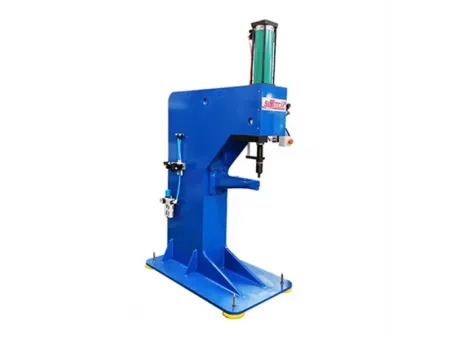
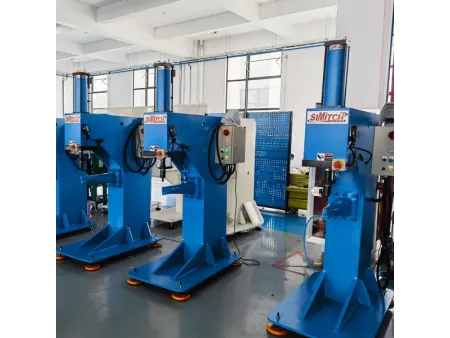
The TCEU clinching press is a specialized clinching system designed specifically for the HVAC and refrigeration industries. It is engineered for the high-volume production of standard-sized ventilation ducts. Featuring an extra-deep throat and a robust frame, this press series is highly adaptable to meet specific customization requirements.
Dimensions
| Model | Max. Capacity | A | B | C | D | E | ||
| kN | T | |||||||
| TCEU | 8 | 78 | 7.8 | 935 | 700 | 1100 | 500 | 60 |
System Configuration
- Pneumohydraulic Cylinder
- TCEU Press Body
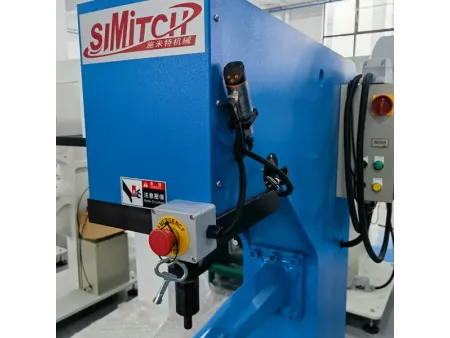
- STE Safety Control System
Key Advantages
- Simplified Power Drive: Utilizes an advanced pneumohydraulic cylinder as the primary power actuator.
- Generates 2kN-2000kN of pressing force using only 2-8 bar compressed air, eliminating the need for complex hydraulic power units.
- Pressing force is infinitely adjustable within the specified range.
- Unique "Adaptive" Pressing Technology: The power stroke is automatically triggered at any point within the total stroke upon contact with the workpiece.
- No stroke adjustment is required when changing tools or workpieces. During the power stroke, the force automatically adapts to load changes, optimizing the assembly process.
Applicable Processes
- Forming
- Testing
- Stamping
- Embossing
- Drawing
- Sealing
- Riveting
- Cutting
- Bending
- Compression
- Clinching
- Press fitting
Product Applications
- Damper Blade Clinching
- Fire Damper Assembly
- Air Damper/Volume Control Damper (VCD) Assembly
- Duct Seam Joining/Ductwork Clinching