Twin-Screw Plastic Pelletizing System


Request a Quote
Counter-Rotating Twin-Screw Extrusion and Strand Pelletizing
Video
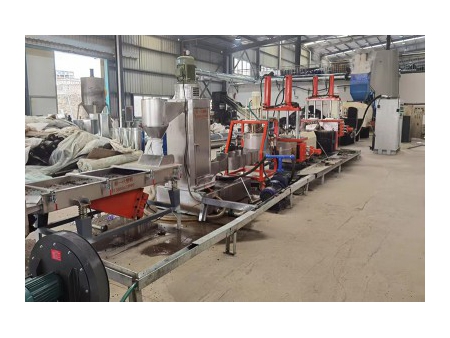
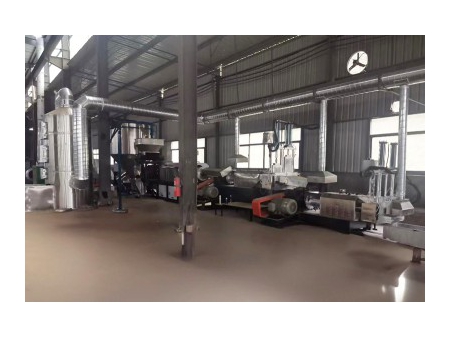
The large-scale counter-rotating system is designed for re-pelletizing a wide range of recycled plastics. It is suitable for rigid regrind materials such as PP, PE, PS, and ABS. The plastic recycling line can be configured as a double-stage or triple-stage pelletizing system. The finished pellets can be reused as raw material for downstream processes, including injection molding, film blowing, and pipe extrusion.
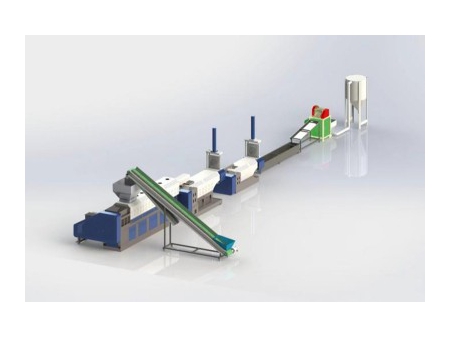
The twin-screw triple-stage pelletizing line consists of one counter-rotating twin-screw extruder combined with two single-screw extruders.
- First stage
The counter-rotating twin-screw extruder handles solid conveying, compaction, melting, and initial plasticization. It delivers very high conveying efficiency and strong extrusion pressure. The pelletizing line is suitable for rigid recycled materials. - Second stage
A single-screw extruder is used to further homogenize the molten material from the first stage. This stage focuses on pressure build-up, melt stabilization, and effective degassing. - Third stage
A second single-screw extruder is responsible for final pressure build-up, stable extrusion, and pelletizing. This stage ensures consistent pellet shape and quality.
Specifications
| Model | ||
| Screw Diameter (mm) | 150 | 160 |
| Screw Speed (rpm) | 60-150 | 60-150 |
| Power (kW) | 75 | 110 |
| L/D Ratio | 20-30 | 20-30 |
| Output Capacity (kg/h) | 500-1000 | 1000-1500 |
(Optional auxiliary extruder screw available.)
Features
- The two horizontally arranged screws rotate inward in opposite directions, which creates a high conveying force.
- Mechanical energy is directly converted into melt heat. At the same production level, counter-rotating twin-screw systems usually consume less energy than other extruder types, which reduces overall operating costs.
- A smart control system is integrated into the line that controls the processing conditions by managing barrel temperature zones, die-head pressure, and screw speed output.
Is this pelletizing line suitable for plastic film?
Is this pelletizing line suitable for plastic film?
Plastic films come in many types and are usually bulky and lightweight. The feeding efficiency and production capacity are limited with standard single-screw pelletizing lines. A three-stage counter-rotating twin-screw pelletizing line is recommended for recycled plastic films. The first stage focuses on efficient feeding and melting, while the later stages handle homogenizing, degassing, and filtration. The finished pellets can be reused for injection molding or film blowing.
Why do large-scale rigid plastic recyclers often choose counter-rotating twin screw lines?
Why do large-scale rigid plastic recyclers often choose counter-rotating twin screw lines?
Counter-rotating twin screw line provides stronger solid conveying and higher extrusion pressure when processing rigid plastic scrap. The line maintains steady extrusion while keeping energy use low, even in high-output production.
How does a three-stage counter-rotating twin screw line handle difficult PS or ABS regrind?
How does a three-stage counter-rotating twin screw line handle difficult PS or ABS regrind?
The first counter-rotating twin screw compacts and melts the material efficiently. The second stage improves melt uniformity, builds pressure, and removes trapped air or moisture. The third stage stabilizes extrusion and forms pellets. The twin screw line with the three stages integrated together is well suited for rigid materials with high impurity levels or strict pressure control requirements.