Ball Mill


Request a Quote
Video
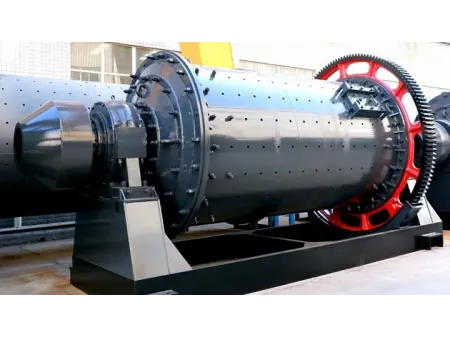
Ball mills are grinding mills used after the crushing stage when the material needs to be processed into fine or ultra-fine powder. Inside the horizontal rotating cylinder, grinding media impact and grind the material as the drum turns, reducing ore, cement clinker, limestone, quartz sand, ceramic raw materials, coal, slag, chemical raw materials, metal oxides, and other medium-hard or hard materials to the required fineness. Depending on the material and production requirements, ball mills can be used for either dry or wet grinding in metallurgy, cement production, mining, building materials, and chemical processing.
Technical Specifications
| Model | Cylinder Speed (rpm) | Grinding Media Load (t) | Feed Size (mm) | Output Size (mm) | Capacity (t/h) | Motor Power (kW) |
| 38 | 1.5 | ≤20 | 0.075-0.89 | 0.65-2 | 18.5 | |
| 38 | 2.51 | ≤20 | 0.075-0.89 | 1.1-3.5 | 22 | |
| 32 | 3.8 | ≤25 | 0.075-0.6 | 1.5-4.8 | 30-45 | |
| 32 | 5 | ≤25 | 0.074-0.4 | 1.6-5 | 30-45 | |
| 32 | 7 | ≤25 | 0.074-0.4 | 1.6-5.5 | 55 | |
| 27 | 8 | ≤25 | 0.074-0.4 | 2-5.8 | 75-90 | |
| 27 | 14 | ≤25 | 0.074-0.4 | 3-6.5 | 90-110 | |
| 27 | 15 | ≤25 | 0.074-0.4 | 3.5-8 | 110-132 | |
| 24 | 11 | ≤25 | 0.074-0.4 | 4-10 | 132-180 | |
| 24 | 23 | ≤25 | 0.074-0.4 | 6.5-15 | 210 | |
| 24 | 25 | ≤25 | 0.074-0.4 | 7.5-17 | 210-245 | |
| 21 | 30 | ≤25 | 0.074-0.4 | 10-22 | 370 | |
| 21 | 31 | ≤25 | 0.074-0.4 | 14-26 | 380 | |
| 21 | 33 | ≤25 | 0.074-0.4 | 15-29 | 475 | |
| 21 | 39 | ≤25 | 0.074-0.4 | 16-33 | 475 | |
| 21 | 51.5 | ≤25 | 0.04-0.08 | 16-35 | 630 | |
| 21 | 39 | ≤25 | 0.074-0.4 | 16-29 | 475 | |
| 21 | 43.5 | ≤25 | 0.074-0.4 | 20-35 | 500 | |
| 18 | 65 | ≤25 | 0.074-0.4 | 25-40 | 800 |
Features
- The main grinding parts are equipped with wear-resistant alloy liners and grinding media, which helps the ball mill handle impact and abrasion during continuous operation while reducing how often these parts need to be replaced.
- A fully enclosed structure helps limit dust leakage during operation, and dust collection ports can be connected to a dust removal system for cleaner production.
- Feeding, discharge, lubrication, and cooling can be integrated into the control system, making operation more straightforward and maintenance easier.