Static Var Generator (SVG), Low Voltage

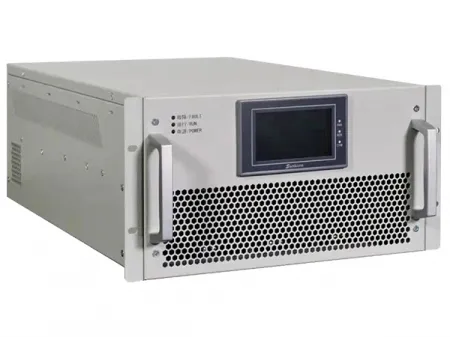
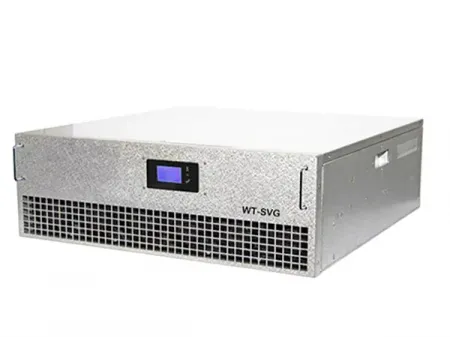
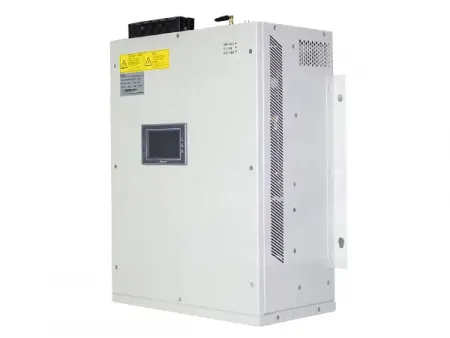

Electronic reactive power compensation device for enhancing power quality by dynamically compensating reactive power
- Rated capacity: 30 kVAr / 50 kVAr / 50 kVAr /100 kVAr
- Operating voltage: Selectable 400 ± 20% / 220 ± 15% / 690 ± 15% / 750 ± 15% / 800 ± 15%
- Operating frequency: 50 / 60 Hz ± 5 Hz
- Reactive compensation: -100% to 100% (power factor is adjustable within the range)
- Ambient temperature: -10℃ to 45℃
- Enclosure protection level: IP20 as standard (higher protection levels are customizable upon request)
A Static Var Generator (SVG) helps keep voltage stable and power quality consistent by managing reactive power in real time. It adjusts automatically to balance the power factor and reduces energy losses, creating a more reliable and efficient electrical system. Unlike traditional capacitor banks, an SVG reacts quickly to sudden changes in load, ensuring smooth and accurate compensation. It’s widely used in factories, commercial buildings, and data centers where a steady and dependable power supply is essential.
Below are low-voltage static var generators (SVG) main performance highlights that make them an effective solution for modern power systems:
- Respond within milliseconds to adjust reactive power in real time, maintaining voltage stability and minimizing flicker caused by sudden load changes.
- Continuously track reactive power fluctuations with high accuracy, improving the power factor and reducing unnecessary energy losses.
- They adapt automatically to load variations, optimizing power distribution and supporting steady system performance.
- Compensate both inductive and capacitive loads at the same time, overcoming the limitations of traditional capacitor-based systems.
- Reduce harmonic interference and can include dedicated modules for filtering specific harmonics to improve power quality.
- Support voltage stability by regulating reactive power flow, preventing equipment damage from voltage spikes or drops.
- Thanks to their compact design and low internal losses, they are easy to install and simple to maintain, which helps reduce downtime and overall maintenance work.
- Avoid risks such as capacitor degradation, resonance, or sparking, ensuring stable operation even under demanding conditions.
- Enhance grid performance with integrated harmonic filtering and voltage support functions, improving system reliability.
- Balance three-phase systems by controlling neutral line current, effectively addressing unbalanced load issues.
- Use active damping control to prevent harmonic amplification that can occur with conventional LC filters.
- Offer high conversion efficiency and modular layouts available in wall-mounted or rack-mounted versions, supporting N 1 redundancy for uninterrupted operation.
| General | Product type | Static Var Generator (SVG) | |||
| Rated capacity | 30kVAr | 50kVAr | 75kVAr | 100kVAr | |
| Operating voltage | Selectable 1. 400±20% 2. 220±15% 3. 690±15% 4. 750±15% 5. 800±15% | ||||
| Operating frequency | 50/60Hz±5Hz | ||||
| Power factor | -1 to 1 | ||||
| Wiring method | Three-phase, three-wire | ||||
| Current sampling | 5A (CT:100/5– 10000/5) | ||||
| Current sampling position | Selectable 1. Load side 2. Grid side | ||||
| Parallel operation | Unlimited number of units | ||||
| Cooling method | Intelligent forced air cooling | ||||
| Reactive compensation | -100% to 100% (power factor is adjustable within the range) | ||||
| Instantaneous response time | < 100μs | ||||
| Full response time | < 10ms | ||||
| Noise level | < 65dB | ||||
| Protection functions | Self-diagnosis and multiple protection features including over-voltage, under-voltage, frequency anomaly, over-temperature, over-current, short-circuit, phase-loss, DC bus over-voltage, DC bus under-voltage, IGBT fault, and inverter bridge reverse protection | ||||
| Communication & Control | Extended functions | 10-channel TSC interface, capable of operating in combination with TSC/TSF | |||
| Communication interface | RS485 port | ||||
| Communication protocol | Selectable 1. Electricity master protocol 2. Modbus protocol 3. TCP/IP protocol | ||||
| Remote control | Supported (all parameters can be configured through the host computer) | ||||
| Display information | Displays grid parameters such as voltage, current, power, and harmonics | ||||
| Monitoring method | Selectable 1. Independent module monitoring 2. Centralized module monitoring | ||||
| Operating environment | Ambient temperature | -10℃ to 45℃ | |||
| Storage temperature | -40℃ to 65℃ | ||||
| Relative humidity | ≤95%, non-condensing | ||||
| Altitude | ≤1500m (for every 100m above 1500m, rated power decreases by 1%) | ||||
| Enclosure protection level | IP20 as standard (higher protection levels are customizable upon request) | ||||
| Installation | Selectable 1. Wall-mounted (modular) 2. Rack-mounted (modular) 3. Cabinet type (integrated) | ||||
| Wiring method | Selectable 1. Bottom entry 2. Top entry | ||||
- Heavy Industry
- Data Centers and Hospitals
- Renewable Energy Systems
- Power Distribution Systems
- Tire Manufacturing Industry
When equipment on a 380V low-voltage network shows large reactive power fluctuations, should a low-voltage SVG be selected or another type of compensator?
For systems operating on a 380V network where reactive power fluctuates significantly, a low-voltage SVG provides an effective and reliable solution. By responding in less than 50 milliseconds, it delivers precise real-time compensation that keeps voltage stable and the power factor balanced. Thanks to their fast and accurate response, low voltage static var generators are suitable for intermittent loads such as welding robots and variable frequency drives, helping prevent both overcompensation and undercompensation during operation.
What is the operating principle of a low-voltage SVG?
A low-voltage SVG works by using a self-commutated bridge circuit that connects in parallel to the power grid. It continuously measures the reactive power of the system and injects an equal but opposite reactive current to balance it. This real-time adjustment keeps the power factor close to unity and ensures stable voltage under dynamic load conditions.
What maintenance do low-voltage SVGs require?
These devices have minimal maintenance requirements because they use electronic components instead of capacitors or mechanical switches. Regular checks of ventilation, dust cleaning, and system monitoring are usually sufficient to ensure long-term stable performance and prevent overheating or component wear.