Bis(4-tert-butylcyclohexyl) peroxydicarbonate (BCHPC)
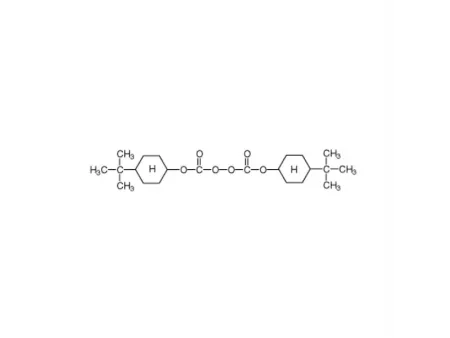
- Chemical Family Organic Peroxide
- Molecular Formula C₂₂H₃₄O₆
- Molecular Weight 398.5
- EINECS 239-557-1
- UN No. 3114
- Transport Hazard Class 5.2
Half-Life Period
- 0.1 hour 82℃
- 1 hour 64℃
- 10 hours 48℃
- Theoretical active oxygen content: 4.01%
- Purity: ≥95.0%
- Self-accelerating decomposition temperature (SADT): 40℃
- Hazardous temperature (Tem): 35℃
- Temperature control (Tc): 30℃
- Storage temperature (Ts min/Ts max): 20/0℃
- Activation energy: 126.39kJ/mol
- Appearance: White powder
- Inorganic/organic hydrolyzable chloride:
- Major decomposition products: carbon dioxide, 4-tert-butyl-cyclohexanol, 4-tert-butylcyclohexane
- This ester peroxide compound is a new type of initiator used for the aqueous suspension polymerization of vinyl chloride. When combined with LQ-CUPN (Cumyl peroxyneodecanoate) and LQ-LPO (Lauroyl peroxide), it enhances reactivity, working efficiently within a polymerization temperature range of 40-65°C.
- It also serves as a curing agent for unsaturated polyesters, particularly for high-end products requiring a wide temperature range. When combined with LQ-TBPB and LQ-CH335, it offers superior curing properties.
-
Packaging
The standard packaging consists of a 20 kg corrugated box containing four 5 kg plastic bags. Customized packaging sizes can also be provided upon request.
-
Storage
Store the product in a well-ventilated area, ensuring the container remains tightly sealed. The maximum storage temperature should not exceed 25°C. Keep it away from reducing agents such as amines, acids, alkalis, and heavy metal compounds. Avoid repacking or handling the product in the warehouse.
-
Validity
If stored under recommended conditions, the product maintains its quality for up to three months.
-
Safe Handling
Keep the material away from any sources of heat, fire, or sparks.
Avoid exposure to reactive substances such as acids, alkalis, or reducing agents, as well as heavy metal compounds (including accelerators and metallic soaps).
For more detailed safety information, please refer to the product's Material Safety Data Sheet (MSDS).